

 EN
EN  English
 中文简体
中文简体News

What is the difference between single and double ear clamps?
 2026.03.27
 Industry News
Single ear clamps use one crimping ear for a quick, secure seal on thin-walled or flexible tubing, while double ear clamps use two ears for higher clamping force and better stability on larger or high-pressure applications. Choosing between them depends on the tubing diameter, material, pressure requirements, and how permanent the connection needs to be.
What Is a Single Ear Clamp?
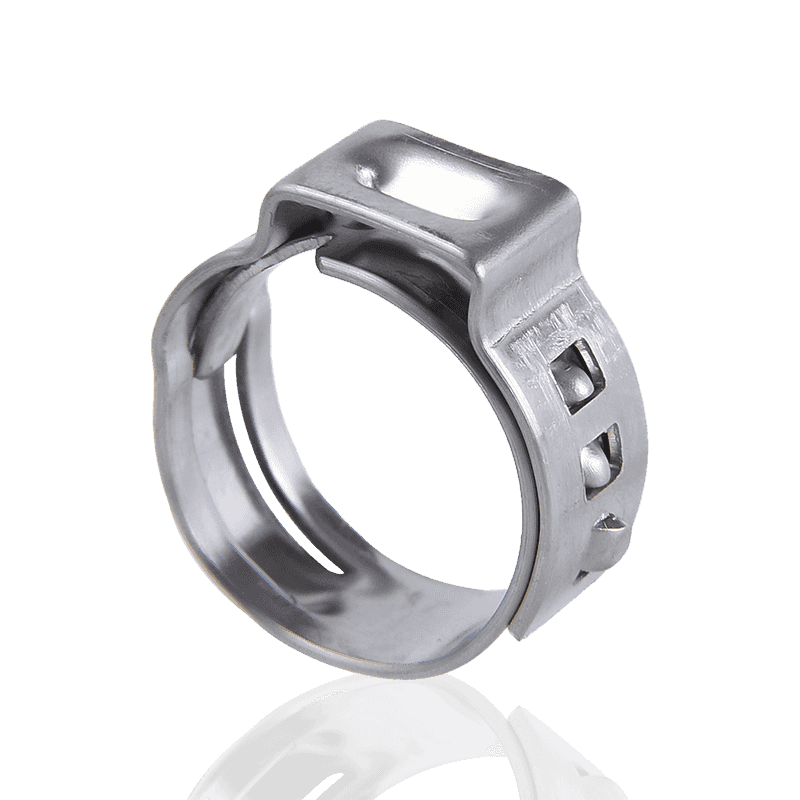
A single ear clamp—also called a one-ear clamp or Oetiker-style clamp—is a stainless steel band with a single raised loop, or "ear," that is crimped using a pincer tool. Once the ear is compressed, the band contracts uniformly around the hose or tubing, creating a permanent, leak-proof seal.
These clamps are commonly used in automotive cooling systems, fuel lines, medical tubing, and plumbing applications where space is limited and a low-profile connection is preferred. The finished clamp sits nearly flush against the hose, making it ideal for tight installations.
Typical Specifications
- Diameter range: typically 8 mm to 32 mm
- Band width: usually 7 mm to 8 mm
- Material: 300-series stainless steel in most standard versions
- Installation: requires a dedicated ear clamp pincer or crimping tool
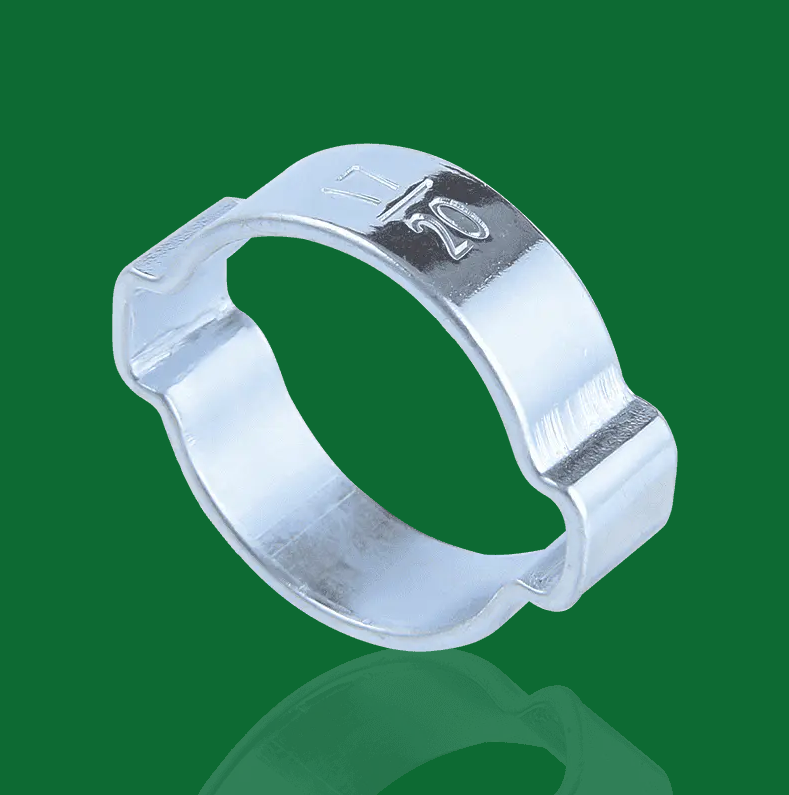
What Is a Double Ear Clamp?
A double ear clamp features two raised ears positioned symmetrically along the band. Both ears are crimped simultaneously or in sequence during installation. The dual-point compression distributes clamping force more evenly across a wider area, which is especially important for larger diameter tubing or stiffer hose materials.
Double ear clamps are frequently used in constant velocity (CV) axle boot applications, air ducts, and industrial hose assemblies where higher torque or vibration resistance is required. They are capable of handling hose diameters that would be unsuitable for a single ear design.
Typical Specifications
- Diameter range: typically 20 mm to 80 mm and beyond
- Band width: usually 7 mm to 13 mm
- Material: stainless steel or zinc-plated carbon steel
- Installation: requires a wide-jaw or double-ear crimping tool
Side-by-Side Comparison
The table below summarizes the most important differences between single and double ear clamps across key performance and application factors.
| Feature | Single Ear Clamp | Double Ear Clamp |
|---|---|---|
| Number of ears | 1 | 2 |
| Clamping force distribution | Single-point | Dual-point, more even |
| Typical diameter range | 8–32 mm | 20–80+ mm |
| Profile after installation | Low profile | Slightly higher profile |
| Best for | Small diameter, thin-wall tubing | Larger diameter, stiffer tubing |
| Vibration resistance | Moderate | High |
| Common applications | Fuel lines, medical tubing, coolant hoses | CV boots, air ducts, industrial hoses |
| Removal after crimping | Not reusable; must be cut off | Not reusable; must be cut off |
How Clamping Force Differs Between the Two Designs
When a single ear clamp is crimped, all the tension in the band originates from one point. The band must be designed to transmit that tension evenly around the full circumference of the hose. This works reliably for smaller diameter tubing (typically under 25 mm) where the band is short enough that pressure remains consistent around the entire seal.
With larger diameters, a single point of tension can result in uneven sealing—one side of the band may press harder than the other. Double ear clamps solve this problem by splitting the clamping action into two symmetrical contact points, which significantly reduces the risk of leaks caused by uneven pressure distribution. For applications above approximately 30 mm in diameter, double ear designs are generally the more reliable choice.
Installation Process and Tooling
Both clamp types require a dedicated crimping tool—standard hose clamp pliers will not produce a reliable seal. However, the tools differ in jaw geometry.
Single Ear Clamp Installation
- Slide the open clamp over the hose before connecting the fitting.
- Push the hose fully onto the fitting barb or nipple.
- Position the ear over the center of the fitting's retention groove.
- Compress the ear fully with a narrow-jaw pincer tool until the jaws close.
- Verify the ear is fully collapsed with no visible gap between the legs.
Double Ear Clamp Installation
- Slide the open clamp over the hose or boot before assembly.
- Seat the component fully onto the shaft or fitting.
- Center the clamp over the sealing lip or groove.
- Use a wide-jaw or double-ear crimping tool to compress both ears simultaneously or one at a time.
- Check both ears are fully crimped and the band sits flat against the surface.
Neither clamp type should be reused after removal. Cutting the band is the correct removal method; attempting to pry or unbend a crimped ear weakens the metal and compromises the clamp's integrity.
Common Application Scenarios
Where Single Ear Clamps Excel
- Automotive fuel and coolant lines: small-diameter hoses (typically 8–16 mm) where space between components is minimal
- Medical and laboratory tubing: clean, low-profile seal required for silicone or PVC tubing
- Residential plumbing: PEX crimp rings (a related single-ear design) used on 1/2" and 3/4" water supply lines
- Appliance and HVAC drainage: condensate drain hoses where low pressure is involved
Where Double Ear Clamps Are Preferred
- CV axle boots: the most common double ear application; boots are large, flexible, and subject to constant rotation and flexing
- Turbocharger and intercooler hoses: larger diameter silicone hoses with moderate boost pressure
- Industrial pneumatic and hydraulic hoses: where vibration or thermal cycling is significant
- Agricultural and construction equipment: larger hose assemblies exposed to harsh outdoor conditions
Material and Corrosion Considerations
Both clamp types are available in stainless steel (most commonly 304 or 316 grade) and carbon steel with zinc plating. For applications exposed to moisture, salt, or chemicals, stainless steel is strongly recommended—zinc-plated versions can begin to show corrosion within 12–24 months in outdoor or marine environments.
316 stainless steel provides better resistance to chloride environments (such as marine or coastal use) compared to the more common 304 grade. For most general automotive and plumbing applications, 304 stainless is adequate and more widely available.
How to Choose the Right Clamp for Your Application
Use the following decision points to select between the two designs:
- Hose diameter under 25 mm: a single ear clamp is typically sufficient and easier to install in tight spaces
- Hose diameter over 30 mm: choose a double ear clamp for more even pressure distribution
- High vibration environment: double ear provides better fatigue resistance due to balanced clamping load
- Very limited radial clearance: single ear's lower post-crimp profile may be necessary
- Stiff or thick-wall hose material: double ear clamp provides the greater clamping force needed to compress the material fully
- OEM replacement specification: always match the clamp type specified by the manufacturer to maintain correct sealing geometry
When replacing a clamp on an existing assembly, the safest approach is to match the original clamp type, size, and material exactly. Substituting a different design—even one that appears to fit—can result in insufficient sealing force or an inability to seat correctly on the fitting's retention groove.

The company strives for excellence in every aspect of production, sales, and after-sales, ensuring customer satisfaction is the unchanging purpose of the enterprise!
Quick links
Product links
Contact Us
-
Address:222 Zhouhu Road, Zhouxiang Town, Cixi City, Zhejiang Province, China
-
Phone: +86-13736108443
-
Tel: +86-574-63441573
-
Fax: +86-574-63452355
-
E-mail: [email protected]
Copyright ©Cixi Hengtuo Hardware Co., Ltd. Rights Reserved. Wholesale Hose Clamp Manufacturer China Hose Clamp Factory
